PFS 2D Pipeline Overview
The latest PFS 2D data reduction pipeline (DRP) is now based on the third generation (Gen3) LSST middleware. The PFS pipeline organizes data using key terms:
-
visitrefers to a unique exposure identifier. -
spectrographdefines the spectrograph module with an integer ranging from1–4. -
armdefines the spectrograph's blue, red, near-IR, and medium-resolution red arms (b,r,n,m). -
catIdspecifies the catalog source of an object. -
objIdis a unique (within a catalog) 64-bit identifier for an astronomical source. -
pfsDesignIdencodes the fiber configuration. -
pfsVisitHashuniquely defines a set of combined visits.
More details can be found in Appendix.
PFS 2D DRP Workflow
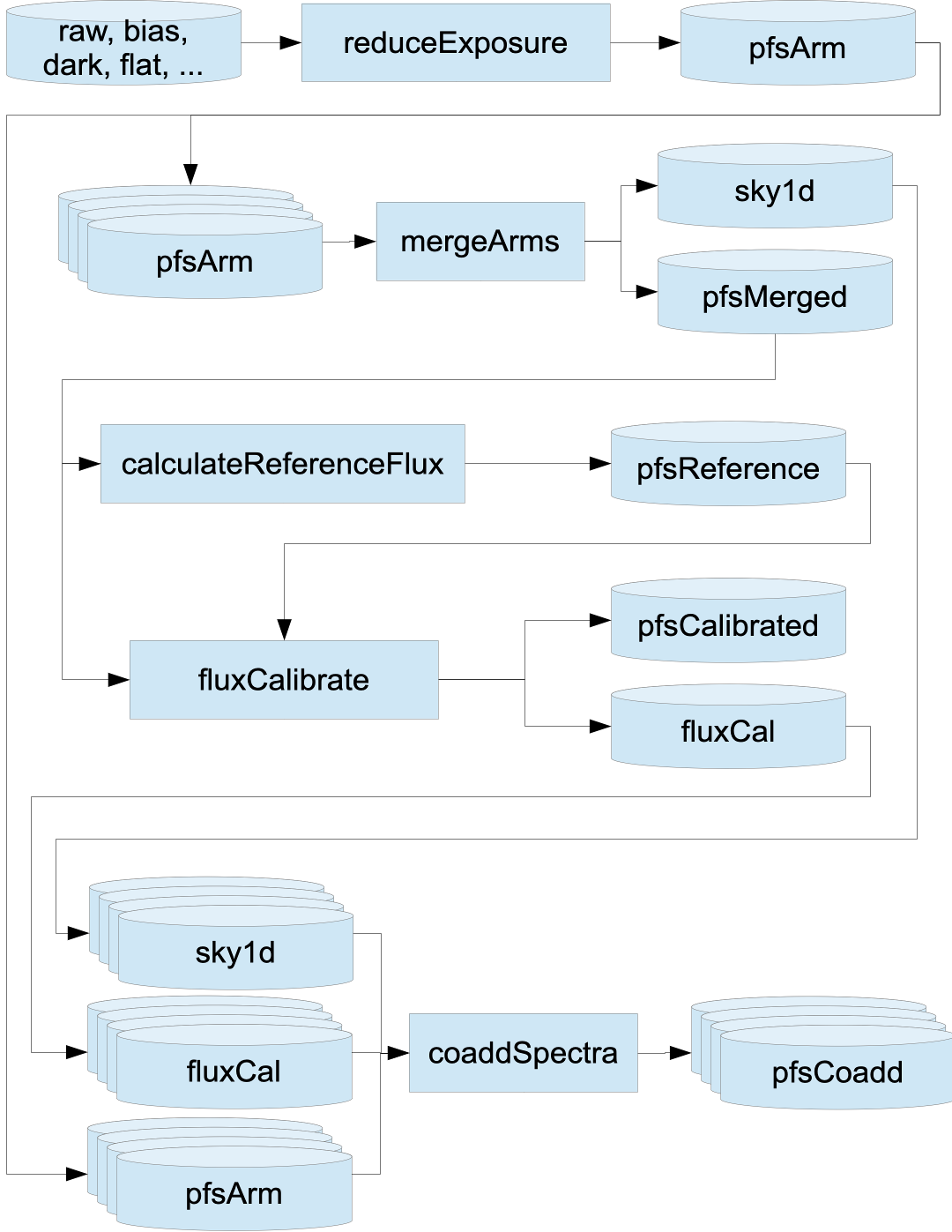
The PFS 2D DRP workflow is shown in the flowchart below.
Products
pfsArm: These are wavelength-calibrated but not sky subtracted or flux calibrated single spectra from a single visit and a single arm.pfsMerged: These are arm-merged, wavelength calibrated and sky subtracted (but not flux calibrated) spectra from a single visit.pfsCalibrated: These are flux-calibrated, arm-merged, wavelength calibrated, and sky subtracted spectra from a single visit.pfsCoadd: These are coadded spectra, and the final products for science.